Sunday 18 October 2009
I’m sitting in the laundry trailer at Camp Sather, Baghdad, Iraq attempting to remove some of the travel filth from my clothes. Don’t worry, Barbara, I’m sure that this skill, along with the ability to set an alarm clock and determine the directionality of artillery/mortar fire, will dissipate soon after my return. This has been a pretty outstanding trip, so far. I’m here to essentially close down the medical research efforts in Iraq as the medical system redeploys out of this war zone. The plans are already in motion for the redeployment of our medical forces, down to the single man level of detail, but I don’t want to get ahead of myself. Redeploy, by the way, is army-speak for deployment in reverse, ie- getting out of the country. Kind of like ‘retrograde attack’ means retreat. Not sure why we talk this way.
It took us two days to get out of Bagram/Afghanistan. It’s hard to really put that into perspective for you. Rather than spending time on the phone with a travel agent trying to arrange the perfect flight, this means humping your body armor, ruck, helmet, weapon, and whatever you might need for a two week trip to Iraq about a mile to the PAX (travel) terminal for every possible flight, three hours in advance of every flight time, which isn’t released until 2300 the night before. We did this 5 times on the first day, to no avail. Finally on the second day, we were able to catch a flight to Al Udeid, Quatar. I should mention that I am traveling with an O-6, which is usually the equivalent of a wartime, golden hall pass. An O-6 can pretty much get whatever he wants in theatre, and whatever he says usually goes. Except for travel out of country. R&R and combat missions take priority, and both happen to be quite in vogue in Afghanistan, right now.
We landed at Al Udeid about midnight and found our tents. Since it is an Air Force base, they have an O-6 tent, then an everybody-else tent. I think the U.S. Air Force is the last vestige of communism. Anyway, I of course managed to sneak my way into the O-6 tent for the night, which was a great upgrade. Heck, it's not that much of a stretch, I figure I’ll be one, someday. Ooh, inspiration for another fieldcraft piece. I’m not actually sure that the folks at Al Udeid know that there is a war going on, but it was amazing- everything is clean, there is wi-fi internet, they even took away our weapons, which was disconcerting. I haven’t walked around without one for over two months. I found myself constantly checking my hip with my hand as I used to do with my pager in a former life. I got a good 4 hours of sleep, then loaded up for the flight to Iraq.
This being the deployed environment, if not a war zone, our plane malfunctioned while on the runway and we got to sit in a sweltering C-17 for about two hours while they worked on it. Pretty standard, combat zone stuff. Of course we are in Quatar, which is in the Middle East, which is hot. Squiggly vision, Koran chants echoing from the top of minarets, hot. The problem was that they couldn’t get their power to work while on the ground. If the engines were running, there wasn’t a problem. The challenge would come, of course, when they had to stop the engines and drop off their cargo in Tikrit, Iraq before heading on to Baghdad (my destination). How would they get the engines restarted? The answer seemed fairly obvious- keep the engines running while you offload the equipment. It wouldn’t have been so dramatic, but the cargo happened to be a full fuel truck and two full, 5000 lb liquid oxygen containers. No problem, they decided to drive on. Apparently, you can’t smoke a cigarette within 50 feet of either a fuel truck or an O2 container, but 4 jet engines in direct proximity to the flammables don’t pose much of a risk. Got it- I’m ok with that. Besides, I need to get to Baghad. By the way, it worked.
Landing in Baghdad, I was once again amongst my Army brethren. Our camp consists of tents with the requisite amount of dust/dirt and eau de port-a-potty. Perfect. I’m back home. I spent the morning at the 10th Combat Support Hospital, where I ran into a bunch of friends from Tripler. Dwight Kellicut, a vascular surgeon from TAMC, is here. He’s lost 49 pounds during this deployment, so far. Our CT surgeon from TAMC is also here along with an OB/GYN from Tripler. They’re doing well. Iraq is incredibly quiet. No real American traumas, thank God. Everyone is spending their time planning the draw-down and listening to the reports from Afghanistan. I wish I could describe the looks I get when they hear I’m at Bagram. Priceless- I actually love it. I’ll self-analyze my reaction at some point in the future. We’re quite close to Baghdad Int’l Airport, by the way, which was well depicted in a battle scene in the HBO mini-series “Generation Kill.”
I spent the afternoon at Al Faw palace, one of Sadam’s former homes. It is quite stunning and is now Multi-National Corps- Iraq HQ. I had to meet with the top Army medical staff in Iraq to discuss the drawdown plans for medicine and research in Iraq. The MNC-I surgeon (top doc in theatre) is Dallas Homas, a former colleague from Tripler, and his deputy is Wilma Larsen, former Dept Chair of Ob/Gyn at Tripler. I think we’re supporting this war out of the Pink Palace, sometimes. Either that, or I’m just getting older and have been around for too long. The meetings lasted for a few hours and went great, we’re all on the same page with our plans. I am very impressed with the medical war plans that I hear about. These people are on it. Mostly, I’m glad that there is essentially no trauma in Iraq and we are really winding down in this theatre.
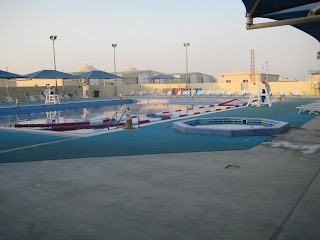
I head up to Balad tonight to finish up business, here. I hear Balad has a pool and is no longer deserving of the title “Mortaritaville.” Excellent. I’ve kind of felt like I’m on R&R in Iraq. How strange to write that sentence. I think my stuff is ready for the dryer.
18 October 2009, cont.- PAX terminal, Baghdad
I was on a bus last night from Al Faw Palace back to Sather and had the joy of eavesdropping on the philosophical contemplations of some young soldiers. These were the same guys that I listened to on the airplane to Kuwait, except that they were different people. The bus was dark, about half-full, and idling at the stop, waiting for departure. The dust is slowly swirling in the dark outside the curtained windows. It’s still about 96 degrees outside, and the hum of the air conditioner is lulling us all to sleep.
“Belks, your ever heard of that saying, ‘money can’t buy happiness.”
“Of course, dumb shit, I’m not stupid.”
“Well, that’s bullshit.”
This is a verbatim transcript of the conversation to the best of my recollection. I wanted to write it down to guarantee accuracy, but it was too dark to see. While these were different people from the plane flight pair, young soldiers are apparently at that age where they are testing and defining the boundaries and truths of their universe.
“Man, I’m tired…I don’t want no theory, right now.”
“Seriously, I mean, whenever I’ve got money, I’m happy as hell. What kind of dumbass would have money and not be happy?”
Maybe these guys are smarter than I realized.