Saturday, February 27, 2010

Bagram to beach


Well, I have made it back home. It is surreal, strange, and amazing. I am thankful for the experience, even more thankful to be back home, and most thankful for my amazing wife and children. We went straight to Lanikai beach from the airport to wash away some of Afghanistan- the perfect homecoming. I hope to be in touch with friends and family as the next few weeks roll along.

Thank you for tolerating my ramblings.

Warmest Aloha,

Joe

Friday, February 19, 2010

Purgatory

Thursday 18 February 2010

I am currently in Kuwait, laying in my cot and listening to the sandy wind blow the tent flaps after making the overnight, 5 hour flight from Afghanistan in a C-17. I must admit that the sand of Kuwait looks a lot more inviting to me while traveling in this direction. I’ll be here for 4 or 5 days before going to Ft Benning, GA to complete the redeployment process.

The feeling is kind of surreal. I can feel my body unwinding, my pulse slowing, a kind of deep fatigue possessing me. I see it in the other redeploying guys, as well. Not as much banter among the guys returning from Afghanistan as one might expect. It seems like guys are sleeping 14 or 16 hours at a stretch.

I watched some news on a TV in the gym tent and am filled with mixed emotions. I am ecstatic to be heading home, but strangely, a little guilty to have left while my friends are there doing important things. I can hear the EOD guys blowing some ordinance in the background. Not sure why they are having controlled detonations in Kuwait.

I am actually thankful to have this temporary stop on the way home. It has been a good chance to unwind and slow down, let the caffeine wear off. I am jaded enough to know that this stop is unlikely intentional on the part of the “system,” but it is worthwhile nonetheless- sort of a soft transition back to our other lives.

You can’t always get what you want,

But if you try, sometimes, you just might find,

You get what you need.

-Rolling Stones

Sunday, February 14, 2010

medics

Sunday 14 February 2010

Until I just wrote today’s date, I had once again forgotten that it’s Valentine’s Day. Being here, my hope is that this transgression will be overlooked (right, B?)

While much about the Army frustrates me beyond words, I don’t think I have ever been prouder to be in the Army than I am today. I just came from an awards ceremony for the 8th Forward Surgical Team, recognizing the work of their medics, in particular. I am extremely flattered to have been asked to present the awards to their medics since I’m not assigned to the unit and I’m not in their chain of command. I have, however, been to their forward operating base several times and have worked closely with their team. It’s also special to me that that the unit happens to be based out of Hawaii.

Their forward surgical team has been the busiest in Afghanistan. So much so, that they were highlighted in an MSNBC piece that I mentioned on this blog several months ago. Their successes have been phenomenal and they have paid a high price- they have had to experience the tragedy of their own medics being severely injured in combat. Beside my clinical ties with this unit, I have worked with their medics and trauma nurses on what has become a very high-profile project to improve the life-saving interventions performed by combat medics. They have been the best in every respect.

I have never before been choked up at a formal military awards ceremony. I wish I could capture that moment and the looks in their young eyes, standing in their worn and faded uniforms, waiting to board their flight to Kyrgyzstan, Europe, then home to Hawaii. I wish I could turn my appreciation, my admiration, my affection for these young people into something tangible. My words seemed so impotent, unworthy of their deeds. I hope to remember their laughter, their sarcasm, the smell of the broken wooden crate bonfire in front of their medical tent, the sight of the stars flying over their dark FOB, my own comical fear that I might have flinched at an outgoing artillery round or flare, belying my nonchalant facade.

Now they head back to their motor pools, medical supply offices, and Tripler clinics where they work. Back to their car payments and pau hanas (happy hours). At the end of the ceremony, their First Sergeant went medic by medic, pointing out their dreams, aspirations, career hopes. Meanwhile, the assault on Marjah progresses as I head up to the smoke shack for a cigar, wondering what the night will bring. I think I’ll have a good one, tonight.

Sunday, February 7, 2010

The tap

Sunday 7 February 2010

It’s about 8 pm and I just walked through the ICU to check on a patient that I operated on Saturday. He’s an ANA soldier who had been injured by an IED. He had a tissue defect just above his right ankle, essentially a 6x 5 inch hole with damaged tendons. On Saturday, an orthopedic surgeon repaired his tendons while I harvested a flap of tissue from his forearm for use in reconstructing the defect. My team sewed an artery and two veins from his leg to an artery and veins from this harvested tissue in order to give it a living blood supply. We did this under a microscope with 9-0 suture that is much finer than a human hair. The closest place to Bagram where you could get this kind of surgery is probably in India, two countries away.

I stood over the patient with my plastic surgeon partner and we congratulated ourselves on our success. We listened to a Doppler device which documents blood flow through the flap and fist-bumped each other in toast. Suddenly, I felt a tap on my shoulder and looked up to see two older Afghan men in traditional Afghan garb pointing to the patient’s head, which I hadn’t noticed. As I walked around the bed, I saw that they were pointing at the rivulet of saliva which was draining from their brother’s mouth in a slow but steady trickle. I had forgotten that the patient also had a head injury from the concussion of the blast. I put on a glove and wiped it away, chiding myself for the descent into myopic vanity. The dark eyes and gentle tap of the Afghan villager who spoke no English provided a crystal-clear reminder that I was apparently in need of.

Sunday, January 31, 2010

The goat

Sunday 31 January 2010

I suppose I should provide some follow-up on the surgeon/patient. He ended up recovering quite nicely at BAF for 2 days, without surgery. He has been sent to Germany for a few weeks of observation to ensure that he doesn’t develop any delayed complications as he is posted in a location where it would take a while for him to reach medical care. Outside of his own, that is. I fully expect that he will be assertive enough to play salmon, swimming upstream against the normal patient flow and make it back to theater.

Yesterday at about 3:30, as I was dutifully and happily working on the transition brief for my replacement, my vascular surgeon friend walked in and told me that a patient had arrived with a gunshot would to the back of the neck and that the bullet was lodged in the soft tissues of his neck. He told me not to worry, though, that they could handle it.

“You just like to turn the bovie (electrocautery) up really high and dig right down to it, right? I mean, it’s just the neck- there’s nothing to hurt in there.”

My keen sense of observation and his half-smirk told me he was just getting my goat, but I was surprised at how quickly he was able to find the soft spots. I guess I’m not as subtle and mysterious as I had hoped. As he walked to the OR, I chased him down the hallway muttering profound things like, “Come on, I mean… no…you can’t…you have to approach…fine.”

The case was actually fun and not very technically demanding. I was able to dig the fragment out from the deep neck musculature quite easily and nothing important had been injured. The whole thing only took about 15 minutes, including my running commentary to the anesthesia team about the incredible degree of difficulty of this case and that only 3 surgeons in the world could pull this off. All of which was totally untrue, as confirmed when the anesthesiologist said that he had seen zits that were more difficult to get out. I think this is a conspiracy.

After the case, I walked into OR #2, where my buddy was doing an intricate vascular repair with a graft to the posterior tibial artery on a patient who had been shot through the lower leg. He had also, incidentally, been shot through the back and stomach, so the general surgeons were doing a laparotomy at the same time.

I asked him if he needed any help as I had recently read that the leg bone is indeed connected to the foot bone and I’d be happy to talk him through it. It’s just the leg, after all, there’s nothing important in there, right? He asked me how my zit went.

Saturday, January 23, 2010

Something

Saturday 23 January 2010

I ran into one of my favorite people yesterday in the smoke shack on the roof, an Air Force vascular surgeon who was intently examining his cigar and immediately said to me in an exasperated tone as I entered our little Shangri La, “You Army guys are something.” I could sense that he wasn’t exactly complimenting me, so I inquired as to the inspiration for this sudden realization. He told me that one of our FOB’s was rocketed yesterday, injuring several medical personnel. One of the casualties was a general surgeon, who was then flown here on a medevac flight for treatment. The surgeon actually walked off of the helicopter and into the trauma room, saying loudly “Where’s the latrine?” As he walked out of the bathroom, he then exclaimed, ”There. Now there’s no need for a foley (catheter).”

After agreeing to finally lay down and get examined, the “patient” said “I’ve already explored the wound- there’s no intraperitoneal injury.” My friend inquired how the surgeon had managed to explore his own wound, upon which he replied, “With my finger.” Some eyebrows were raised, but the patient did agree to undergo imaging (x-ray and CT) studies, which actually showed that he had free air in his belly. This finding indicated that he did indeed have some shrapnel that entered his abdominal cavity, necessitating a laparotomy- a surgery to explore the abdomen and remove the shrapnel. After my friend reviewed the films with him and briefly discussed the procedure, with which both surgeons were of course familiar and which was completely necessary, the patient said, “No.”

“No?”

The patient said that he had no fevers and didn’t want to have surgery or be air-evacuated to Germany. He wanted to be observed for 48 hours, and if he didn’t develop peritonitis (an infected abdomen), he wanted to go back to his FOB and get back to work.

Funny enough, noone has ever said “no” here before. I won’t go into the medical details of the situation, but the request was risky, unusual, and caused a bit of head-scratching on the part of my friend and our entire medical command structure.

I’ll let you know how it turns out.

Wednesday, January 20, 2010

The arena

Tuesday 20 January 2010

I am back at BAF and ran into some of my surgeon friends who were stationed at FOB Ghazni and FOB Salerno (Khost Province). They’re on their way back home and fly out tomorrow. Both groups mentioned that in a strange way, they are kind of disappointed and a bit sad to be leaving. After referring them for immediate cognitive testing and a neuropsych evaluation, I found out that they had been happy with their deployments and universally had very rewarding experiences. One of the surgeons, interestingly, reportedly left FOB Salerno in tears. Part of their melancholy is no doubt associated with the fact that they’re actually on the way home. I still have about 6 weeks left to go and am trying to just keep up the pace and finish strong. Once I let myself really start thinking about home, I’m afraid that time will start to slow. I’m not quite ready to reflect back just yet- there are too many hours and miles between me and Kailua.


While I have very little access or time for media, even I have heard about the recent tragedy in Haiti. I’ve also heard about some of the frustration with the slowness of relief efforts. I am acutely aware of the challenges of providing humanitarian relief in austere environments and was at first frustrated by the critical nature of some reports. Then I thought, how American of us to just assume that of course we would come to the aid of another country and that of course we should be rapid and effective. What other nation expects and demands such perfectly executed compassion? Ultimately, that is likely a good thing and I guess that’s why we are who we are. Before I came to that realization, however, one of my favorite quotes regarding the difference between doers and critics came to mind:

"It is not the critic who counts: not the man who points out how the strong man stumbles or where the doer of deeds could have done better. The credit belongs to the man who is actually in the arena, whose face is marred by dust and sweat and blood, who strives valiantly, who errs and comes up short again and again, because there is no effort without error or shortcoming, but who knows the great enthusiasms, the great devotions, who spends himself for a worthy cause; who, at the best, knows, in the end, the triumph of high achievement, and who, at the worst, if he fails, at least he fails while daring greatly, so that his place shall never be with those cold and timid souls who knew neither victory nor defeat."

-Teddy Roosevelt

I suspect that my departing friends must be feeling the satisfaction of leaving the arena with their heads held high.

Tuesday, January 19, 2010

tulips

Sunday 17 January 2010

I’m currently at Kandahar Air Field (KAF), which is a NATO base in Southern Afghanistan. The weather has been warm (in the 60’s during the day), a blessed relief from the cold of northern and eastern Afghanistan. Since it’s a NATO base, the majority of people at Kandahar are actually not from the U.S., which is also an interesting distraction. Aside from the Tim Horton’s donut shop (which I will not discuss as I’ve just barely come to terms with my gluttony-inspired self-loathing), the most amazing thing about KAF is the NATO gym. It’s run by a civilian company from Amsterdam, and it is the cleanest place I’ve been in 5 months. It very much resembles a health club back home with music playing and weight machines- strikingly different form the Army gym tent at Bagram. I had previously heard that you actually have to change into clean shoes when you get into the gym, which is a problem for me, because I just don’t have anything clean. As I approached the European front desk worker/receptionist, he looked down his nose at me with a pinched expression, as if he had just discovered a worm in one of the tulips in his windmill garden. I can understand Serge’s shock (I’m assuming his name is Serge, though it could just as easily have been Tomas or Sven) at my appearance. I was wearing my stretched, stained workout uniform and shorts with my combat boots, since I don’t have one clean pair of running shoes let alone two that would allow a change. I’m fairly sure that he gagged when he saw my running shoes. I hadn’t noticed until then that my formerly grey New Balance 990’s are now black, cracked, and surrounded by a Pigpen-like cloud/aura/entitiy that is part dust, part stench.

He felt compelled at that point to state, “Ze purpose of ze shoo shange policy ees to shange from derty to clean, not derty to dertier.”

Got it, Sven, it is what it is. I’ll try not to touch anything and I won’t even comment on the Enya CD you just put in. Deal?

He let me in and dove straight for the hand gel. Anyway, they had soccer playing on the TV’s, though thankfully the sound didn’t quite overpower the Enya. Ugh. I did notice a short piece on BBC about Prince William. He was standing in a Royal Air Force uniform along with his father, who was in his Royal Navy uniform. I’m assuming Prince William must have completed some sort of military training. I recall vaguely that his little brother is doing something with the Royal Marines. Though I suspect that neither of them will be dropping 20 pounds with their brethren in Helmand Province or nearly freezing to death along the border of Pakistan, I think it’s neat that they get a little taste of military life.

I will admit to watching a bit of the soccer, since they weren’t showing the NFL playoff games. I know that I am shallow, biased, and woefully underexposed, but I can’t help myself- I just don’t understand the attraction to soccer. I mean, when the players get blazing mad at one another, they run up and kick each other, much like the young girls did on my schoolhouse playground. While I can shamefully admit that those kicks did actually sometimes hurt, I just don’t get it. We were taught as youngsters playing baseball that if you get hit by a pitch, jog nonchalantly to first base as if nothing happened, though it may feel like you just ruptured your spleen. Your teammates would be yelling “Don’t rub it” as you trotted down the first base line. In football, you’re taught to “play through the pain,” or “grin and bear it.” Soccer players, however, seem to suffer an epileptic fit when another player actually happens to graze them, flopping on the ground like a dying fish.

I am happy to report, though, that Chelsea beat Ulster (or Unger or something like that) 7-1. Tomas was ecstatic.

Sunday, January 3, 2010

Resolution

Sunday 3 January 2010

New Year’s Eve and Day came and went with barely a notice. Christmas was recognizable because of the holiday lights hanging inside b-huts, barracks, and in the hospital- the multi-colored kind we keep strung up all year in Hawaii. Christmas trees of different sizes were visible here and there, mostly small ones shipped from home with a handful of token ornaments, infinitely more poignant and profound in their sincerity and simplicity. New Year’s, however, was pretty much ignored. I spent the morning of New Year’s Day with the smell of my daughter’s hair, the squeeze of my son’s tight hug, the feeling of a tender kiss on New Year’s eve somewhere in the back of my mind. The rest of me spent the morning of New Year’s Day in OR #3, operating on a 13 year-old Afghan child that I had seen out in a village when I was on a medical outreach mission. He had a tumor working its way out through the skin of his face, so I did a parotidectomy and neck dissection to remove the tumor. It was nice to be doing head and neck surgery again, rather than trauma surgery or combat trauma research work. Mostly, I guess I was relieved by how much I enjoyed the case. I see it as proof that I will eventually be able to return home to my normal life, finding it fulfilling and well, normal. I’ve only been gone for five months, but it seems strange to imagine a world without the constant sound of helicopters, the smell of outdoor toiletry, the vista of haze and opacity that lurks and obscures.

The real heroes of that case were the guys who went back out to the village to find the child and bring him in. Their daily courage is awe-inspiring. Maybe even more than them, though, I admire the boy. He is a 13 year-old villager who showed up at the hospital to see me with no escort outside of a commando that he didn’t know. I can’t imagine what he must have been thinking and feeling as we walked to the CT scanner, not understanding the language of anyone around him, in an environment that must seem so utterly incomprehensible. Through an interpreter, I explained the scan and the upcoming surgery, and he neither blinked nor flinched. An impassive nod was his sign of assent. One of the commandos was able to track down an older brother who serves as his guardian and has stayed with him since the surgery.

I just checked on him this afternoon and he is doing fine. I have always enjoyed rounding on my patients alone. The patients tend to be more relaxed, I’m less rushed and distracted, and it allows for real communication, even when we don’t speak the same language. When I’m alone, I can sometimes hear my former patients that I carry around with me- the successes and the failures. They remind me of my strengths, my weaknesses. They sometimes scold, sometimes applaud, often remind me of things that I should have remembered but seem to have forgotten, and constantly point out that they will always be there, patiently waiting for me to be quiet and wise enough to listen.

Sunday, December 27, 2009

Team Taliban

Sunday 27 December 2009

This has been a fairly atypical Christmas Day, which I suppose is pretty typical for a war zone.

A few weeks back, one of my team members had a syncopal episode, losing consciousness in the hospital and suffering a pretty good head bonk upon floor impact. The end result was an impressive pool of blood on the floor, some of which managed to trickle under a nearby Christmas tree in the small "dining area" of the hospital, followed by a few staples in the scalp laceration. Today, in the spirit of celebration, another friend of mine performed a song during our team meeting that was written and inspired by the event. The song was entitled "Blood under the Christmas tree" and was a smashing success. I'm not sure that it will replace "Silent Night" as a Christmas classic, but it has a pretty catchy tune, great lyrics, and is certainly original.

Here’s another Christmas story, albeit one you won’t likely want to share with the children fireside. During a village medical outreach mission about a month ago, intelligence came in that the Taliban was going to attack the team. As the security team spread out to the perimeter in order to form a hasty defense, the group of female Afghan interpreters, joined by my female team member, barricaded themselves into the place where they were staying and immediately starting dressing up and putting on make-up. I should add that having a female health care provider in that environment is critical, since Afghan women in most villages will only consent to be seen and treated by women. At any rate, when my female team member inquired as to why they were getting dressed up for the attack, they recounted that their survival strategy was to get dolled up so that if they were captured, they could become hookers for the Taliban. They were very pleased as my team member, who has a light complexion, began to get cleaned and dressed up as well, and they would now be able to offer the Taliban a variety of skin tones from which to choose.

A photo was taken of the potential Taliban hooker team, and my friend actually forwarded it to her husband back home. He then sent it to her father, not recounting the story for the inspiration of the photo. The proud father now displays the photo on his fireplace. The perfect gift for my team member this Christmas, of course, was make-up.

Friday, December 25, 2009

Christmas

For every boot that tramped in battle,
every cloak rolled in blood,
will be burned as fuel for flames.

For a child is born to us, a son is given us;
upon his shoulder dominion rests.
They name him Wonder-Counselor, God-Hero,
Father-Forever, Prince of Peace.

- Isaiah 9, 4-5

Merry Christmas.

Wednesday, December 23, 2009

The potency of medicine


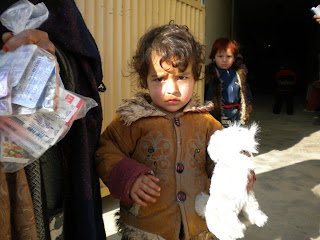
The first photo shows the face of Afghanistan, at least one of them. The second shows one of my team members during a village medical outreach mission. She is literally reaching out to an Afghan child. The mother's crinkled eyes show that she is smiling under the veil. Even a burka can't hide that.

Thursday, December 17, 2009

Logar Province.


This is a photo of Logar Province that I took the day after spending my night of penance for poor judgement. Highway 1, the aorta of Afghanistan, is in the foreground. You can see typical walled-off Afghan compounds on the plain.

Distinctions

Wednesday 16 December 2009

Fieldcraft tip #3: When moving around a combat zone, always travel light. Except during winter in Afghanistan.

I remain humbled at the incredible number of lessons that I continue to learn and relearn as time and life passes. That’s a polite way of saying that I’m amazed at what a dumbass I can occasionally be. One important truism of life in a deployed environment is that it is critical to travel light, since whether you are an E-3 or an O-6, you will eventually be carrying whatever you decide to bring with you on your back. In general, it’s easier to suffer a little bit from the absence of something than it is to consistently carry too much stuff. This has been reinforced through my experiences time and again as I have traveled throughout the combat zone. One critical exception, however, applies when the equipment is necessary to keep you alive. That’s where I made my mistake.

I recently traveled to a forward operating base that is located at over 6,500 feet. I knew that the temperatures at night would hover around 10 degrees F and that I would be staying in a tent, but I figured that since I would be one of the three highest ranking officers on the FOB, the tent would be a “VIP” tent, and certainly heated. I had experienced nights at higher altitudes and colder temperatures in the recent past and been just fine. (Sidenote- if you ever hear an explanation of someone’s reasoning that is this long, it is a guaranteed admission of guilt.) Accordingly, I brought my lighter sleeping bag, a Snugpak Jungle Pack. It is compact, light, sturdy, and totally appropriate for, well… a jungle. Surviving through the night during an Afghan winter, not so much.

That, of course, was exactly the issue. The heater in the tent failed to work, and it seemed that the tent miraculously managed to actually lower the inside temperature below that of the ambient temperature outside. After nightfall, as I transitioned through the uncomfortable phase, passed through misery, and stumbled upon desperation, I finally admitted to myself that an intervention was necessary. I picked up my sleeping bag, which was easy with it being so light and all, and trudged down to an E-6 tent, which had more people, so I figured it would be warm enough to let me survive the night. Fortunately, the soldiers took pity on, or at least indifference to, the idiot officer with a sleeping bag that had mosquito netting sewn around the head end.

I obviously survived the night and am now left to ponder the fact that good rules are only good until they’re not. More importantly, I will now remember to contemplate the often subtle distinction between being savvy and being lazy when making a decision.

Tuesday, December 15, 2009

The enemy within

Sunday 13 December 2009

Thankfully, the clinical pace at the hospital has slowed down quite a bit. There are, however, quite a few “enemies of peace” that are being cared for in our medical facility. “Enemies of peace” is the new, politically correct term for the forces that fight against the Afghan government and Coalition Forces. Personally, I consider constipation to be an “enemy of peace.” These guys are something different. It is interesting to look into their eyes and know that prior to receiving world class medical care in our hospital, they were trying to kill our friends and peers. Most people, fortunately, rarely get to see that look. Well, except maybe for the resident a few years back who claimed during a quarterly review session that I sometimes “looked like I wanted to kill the residents.” Totally untrue. Maybe just hurt them a little. If any residents or members of the Residency Review Committee are reading this, that was totally a joke- an effort to instill comic relief into a piece that I should probably not have posted.

It’s no secret that we provide medical care not only to our friends and allies, but also to enemy forces that are injured in combat. It is, however, an incredible thing that our medical personnel really do deliver the same quality of care to our enemies that we do to our own forces, without hesitation or resentment. I was recently up on the roof of the hospital discussing the matter with a trauma surgeon and he mentioned that he had just finished a pretty amazing and complex surgery on an injured “enemy of peace.” He said, “It’s funny, I’ve done some of my best work on these guys.” At least that’s what I think he said, since we were conversing through gaps between our neck gators and fleece caps that were exactly the diameter of a cigar. The truth is, they really do get our very best.

Thursday, December 10, 2009

Pressure


Thursday 10 December 2009

We had our first snow today here at Bagram. Actually, it was a slushy, icy, 33 degree F, muddifying, Afghanistan version of snow, not the beautifying mountain kind of snow. It was sort of the weather equivalent of learning to snow ski at West Point. That place could even suck the joy out of something as fun as skiing. I still have an image of a heap of bodies (most of them from Southern states) piled at the exit of the ski lift at the top of the ski slope at West Point.

“You bunch of monkeys look like a goddamn Rossignol yard sale!” That comment from the compassionate instructor assigned to the Department of Physical Education would have been funnier had I known at the time that Rossignol was a brand of ski equipment. The fact that his boss was officially titled “The Master of the Sword” should tell you something. It was a fairly accurate portrayal of the situation, however, given the tangle of skis, poles, and various items of inappropriate clothing that lay strewn about. At the time, we had to wear cotton sweat pants and our felt jackets as the uniform for ski class. That, too, is funnier in retrospect because we must have looked like a bunch of snowballs as we caromed down what we considered our “ski mountain.” You can probably imagine the end result of setting loose a bunch of cooped up, late teen/early-20’s adrenaline junkies who have no idea that snow + gravity = danger onto an icy mountain in New York state.

Truthfully, any kind of change is a welcome distraction here and I haven’t heard a “this sucks” in over 2 days. There’s kind of a feeling of anticipation in the air, most likely due to the expectation of more troops arriving and the predictions about whether the optempo will actually slow down this winter, as it has during past winters in this country. The consensus is that it will not, especially given GEN McChrystal’s recent testimony that “victory will result from the prolonged application of pressure.” I guess that’s us.

Tuesday, December 1, 2009

Other side of the world


"Remember those times on the telephone line,
trying to break through to you.
I'm on the other side of this world,
I wish I was there with you.
All these days and all these nights,
thinking about you my friend,
I can't wait to get back home..."

- Donavon Frankenreiter, So Far Away

Until I do get back home, I will do my best to record and share some of my experiences on this journey. I have recently returned from a trip that I will remember for a lifetime. I spent some time at the old Taliban barracks in the picture, above, which is now a coalition medical facility. The operating room is the first door to the right, the trauma room is the first door on the left. This is one of the two or three busiest trauma stabilization sites in Afghanistan. The site is guarded by some Hazaris (like in Kite Runner), which is a good thing because they really hate the Taliban and seem to have an uncanny ability to sniff them out.

My interactions with the Polish Army at this site were moving and memorable. I know that I am completely biased, but I am left with an incredible fondness for the people with whom I worked and interacted. I am fortunate to have worked with some fantastic people, both Polish and American, and I take away memories of laughter echoing off of walls that formerly encompassed scenes of tragedy and terror. I will also remember the sound and feeling of the mournful hymns of a Polish Sunday mass, filled with words that I couldn't understand but a message that was clear.

During the trip, I spent a good deal of time with two American surgeons, a trauma surgeon from the University of Pittsburgh and an orthopod from east Tennessee, about 30 miles from where I grew up. What a small world it is here on the other side of the world.

Thursday, November 26, 2009

Paddling in

Thursday 26 November 2009

It has been a nice Thanksgiving here in Afghanistan, cool and blessedly clear. The snow line is moving down the mountains and I suspect will hit us any day now. People here have two main ways of dealing with holidays. Some prefer to pretend that the holiday doesn’t exist. “Just 1 out of 180, man” is what many say, meaning that it’s just another day of deployment and one more closer to going home. I’ve opted to try to make the best of it, ate some turkey in the chow hall, and my team took turns talking about their favorite Thanksgiving traditions. I detailed how excellent the waves have been on the Windward side of Oahu on every Thanksgiving weekend for the past 8 years and how nice it is to paddle out from my neighborhood into clean, peeling, reef-break waves. After recounting this story, though, I suddenly realized that the best part was actually paddling in, knowing what and who was waiting for me on shore. That’s what I’m really thankful for.

I am going to spend some time with a Polish military unit in the near future. That’s kind of exciting for me, given my Polish heritage. My great-grandfather was apparently in the Polish cavalry, so it’s kind of neat for there to be another Sniezek working with the Polish Army again, 100 years later. I’ve actually been thinking of my Polish roots, lately, hoping that somewhere buried in my genetic code lies an improved tolerance of this cold weather. After all, my name means "snow" in Polish. Eight years in Hawaii has made me pretty soft.

Happy Thanksgiving to my family and friends. You don’t know it, but you just spent a Thanksgiving with me in Afghanistan.

Sunday, November 22, 2009

RIP-TOA

Sunday 22 November 2009

It’s kind of a dusty and dreary Sunday here in Bagram. Or “Runday” as my roommate refers to it, since we usually run our 8 mile loop around the perimeter of the base on Sunday mornings. The air is so full of dust and pollution, today, that the mountains are not visible at all. During the run, somewhere in the midst of a skeptical diatribe that I was delivering and both of us were largely ignoring, my roommate commented that in 20 years, people will be skiing in those mountains. I wittily replied, “What mountains?” Well, it seemed funnier at the time since we were both pretty high from the carbon monoxide being spewed in the exhaust fumes of the jingo trucks passing us on the dusty road.

We had a large turnover of the surgeons last week. The Army calls it a RIP-TOA, for relief in place/transfer of authority. The old crew of surgeons redeployed and the new group just arrived. Being slightly more than half way through my deployment afforded me a somewhat objective perspective to the experience. The guys leaving tried hard (some harder than others) not to gloat or expose their glee at heading home. The new guys were pretty bleary-eyed from the jetlag and bothered by the incessant hacks emanating from their still healthy lungs and airways, not yet compensated to the filth in the air here. Their first real day on the job, we had 13 casualties arrive simultaneously. Welcome to Bagram. The Taliban shot RPG’s and rifles into a bazaar not far from Bagram that happened to be crowded with children at the time. Four of the victims were under ten, and there were several teenagers, as well. While you tend to adapt to anything, even war casualties, seeing children that have been victimized by war wounds is unnatural and haunting. Their little bodies in our trauma room and ICU beds is a sight that I won’t soon forget.

The new team did well and provided great care. One week later, the glazed looks of trepidation are gone, the coughs are resolving, and they appear to have settled into the rhythm of life here. The witty comments and bits of laughter have even returned to rounds, an excellent sign. Like their upper airways, they're adjusting to the grit of deployment. Hard to believe that in about three months, it will be time for my RIP/TOA. I’ll have to remember not to appear gleeful.

Good news- the inauguration went off a few days ago without any major violence or incidents. Everyone was pretty anxious about what would happen. Good cause for Thanksgiving.

Wednesday, November 11, 2009

Ashtrays and mice

Wednesday 11 November 2009

Unfortunately, there was an accident yesterday just outside of the wire at the 8th FST involving some ANA (Afghan National Army) soldiers. The details of the story were recounted to me last night by the FST Commander. The ANA is actually very well respected by coalition troops. They form the lead and tail elements of many patrols and we treat more ANA casualties than Americans or NATO forces. They are a tough lot with their own idiosyncracies, like everyone else. At any rate, five ANA soldiers were apparently in a bunker when one of them threw a cigarette butt down and ignited a fire, cooking off an RPG, which ignited several other RPG’s, injuring all five. There is certainly no humor in that, but after operating on the guys, the surgeons starting passing around a hat for the “ANA ashtray fund.” Pretty good stuff.

I had the pleasure last week of eating an Afghan meal prepared and served by some of the Afghani interpreters who accompany the local outreach efforts. It was certainly the best meal I have had in many months and amazingly, all courses were prepared over one small field stove. There were several curries with potatoes, a long grain rice, and local bread. They also served a tabouli-like salad with spicy peppers. The food was excellent, but the company was even better. I really like the Afghan people who I have met. I suppose I expected most Afghanis to be stoic and stolid, similar to the folks I’ve interacted with in Ladakh and Kashmir, but the Afghanis are more apt to smile, laugh, tease, and joke. Granted, the sample is a bit skewed because these interpreters have a fair amount of interaction with Americans, so they tend to adopt some of our habits and mannerisms, but they have an innate happiness that pleasantly surprised me. Rather than being destroyed by the centuries of war and suffering experienced by their nation, most are generally upbeat, generous, and gracious. The Afghanis who work in the laundry tent are equally as pleasant. About once per week or so, they hide a rubber mouse between the pages of the sign-in book and laugh hysterically when I, or anyone else, looks shocked as it is discovered. Kind of like playing 'pull my finger', the joke just never seems to get old. People are resilient.